The Relationship between Tourist Satisfaction and Service Quality with Recommendation Intention: Study of a Cultural Heritage Site
DOI:
https://doi.org/10.21325/jotags.2021.812Keywords:
Recommendation intention, Tourist satisfaction, Service quality, Cultural heritage sitesAbstract
The purpose of this study is to analyze the relationship between service quality and tourist satisfaction with the recommendation intention of a cultural heritage site. For this purpose, the data was obtained through a structured questionnaire and applied face-to-face to domestic and foreign tourists. The sample is consisted of 400 tourists visiting Bergama cultural heritage sites in August 2019. The chi-square test of independence method was utilized in the analysis of the
developed hypotheses. The findings of the present study revealed that there is a relationship between the recommendation intention of the cultural heritage site with the satisfaction of tourists considering the expenses and time spent. The other finding displayed the relationship between service quality and the recommendation intention of the cultural heritage site. As a result, providing tourist satisfaction and service quality, which has a statistically significant relationship with the recommendation intention of tourists, appeared to be among the main objectives of cultural heritage sites as tourist destinations.
References
Albayrak, A. (2013). Alternatif turizm. Ankara: Detay Yayıncılık.
Anderson, E. W. (1998). Customer satisfaction and word of mouth. Journal of Service Research. 1(1), 5-17. https://doi.org/10.1177/ 109467059800100102.
Anton, J. (1996). Customer relationship management: Making hard decisions with soft numbers. Upper Saddle River, Prentice-Hall.
Arndt, J. (1967). Word-of-mouth advertising and informal communication. In D. Cox (Ed.), Risk-taking and information handling in consumer behaviour. Boston: Harvard University.
Aydoğdu, A., Koç, Y. Z., & Koç, D. E. (2018). Yerli ziyaretçilerin Ilgaz Dağı destinasyonunu tekrar ziyaret etme niyetleri üzerine bir araştırma. Karabük Üniversitesi Sosyal Bilimler Enstitüsü Dergisi, 8(1), 207-226. Süer, S. JOTAGS, 2021, 9(2)722
Bacsi, Z., & Tóth, É. (2019). Word heritage sites as soft tourism destinations – their impacts on international arrivals and tourism receipts, Bulletin of Geography. Socio-economic Series, 45: 25–44. http://doi.org/10.2478/bog-2019-
Baker, D. A., & Crompton, J. (2000). Quality, satisfaction and behavioral intentions. Annals of Tourism Research, 27 (3): 785-804. https://doi.org/10.1016/S0160-7383(99)00108-5.
Barlas, A., Mantis, K., & Koustelios, A. (2010). Achieving positive word-of-mouth communication: The role of perceived service quality in the context of Greek ski centres. World Leisure Journal, 52 (4), 290-297. http://dx.doi.org/10.1080/04419057.2010.9674654.
Beeho, A. J., & Prentice, R. C. (1997). Conceptualizing the experiences of heritage tourists: A case study of New Lanark world heritage village. Tourism Management, 18(2), 75–87. https://doi.org/10.1016/S0261- 5177(96)00103-3.
Bigné, J. E., Sanchez, M. I., & Sanchez, J. (2001). Tourism image, evaluation variables and after purchase behaviour: Inter-relationship. Tourism Management, 22 (6): 607-16. https://doi.org/ 10.1016/S0261-5177(01)00035-8.
Bintarti, S., & Kurniawan, E. N. (2017). Study of revisit intention: Experiential quality and image of Muara Beting tourism site in Bekasi District. European Research Studies Journal, 20, 521-537. https://doi.org/ 10.35808/ersj/657.
Can, A. (2018). SPSS ile bilimsel araştırma sürecinde nicel veri analizi. Ankara: Pegem Akademi.
Eraqi, M. I. (2006). Tourism services quality (TourServQual) in Egypt: The viewpoints of external and internal customers. An International Journal, 13(4): 469-492.
Farid, S. (2015). Tourism management in world heritage sites and its impact on economic development in Mali and Ethiopia, 2nd Global Conference on Business and Social Science (GCBSS), 17-18 September, Bali, Indonesia, Procedia - Social and Behavioral Sciences, 25: 595-604, doi: 10.1016/j.sbspro.2015.11.078.
Getty, J. M., & Thompson, K. N. (1995). The relationship between quality, satisfaction, and recommending behavior in lodging decisions. Journal of Hospitality & Leisure Marketing, 2 (3), 3-22. http://dx.doi.org/10.1300/J150v02n03_02.
Gülhan, D. (2016). Sürdürülebilir kent ve kentsel kimlik örnekler: Birgi ve Bergama. (Doktora Tezi). Ankara Üniversitesi, Sosyal Bilimler Enstitüsü, Ankara.
Hallowell, R. (1996). The relationships of customer satisfaction, customer loyalty, and profitability: An empirical study. International Journal of Service Industry Management, 7(4), 27–42. https://doi.org/10.1108/09564239610129931.
Harris, A. (2014). Word of mouth in tourism: Reflections and directions - a review of word-of-mouth in tourism research. CAUTHE 2014: Tourism and Hospitality in the Contemporary World: Trends, Changes and Complexity, 10-13 February 2014, Brisbane: School of Tourism, The University of Queensland, 261-272.
Harrison, P., & Shaw, R. (2004). Consumer satisfaction and post-purchase intentions: An exploratory study of museum visitors, International Journal of Arts Management, 6 (2), 23-32. Süer, S. JOTAGS, 2021, 9(2)
Hau, T. C., & Omar, K. (2014). The impact of service quality on tourist satisfaction: The case study of Rantau Abang beach as a turtle sanctuary destination, Mediterranean Journal of Social Sciences, 5 (23), 1827-1832. https://doi.org/10.5901/mjss.2014.v5n23p1827.
https://www.tcmb.gov.tr/kurlar/201908/Aug_tr.html (accessed; 15.03. 2020).
Hosany, S., & Withan, M. (2009). Dimensions of cruisers’ experiences, satisfaction, and intention to recommend. Journal of Travel Research, XX(X) 1–14. https://doi.org/10.1177/0047287509346859.
Huo, Y., & Miller, D. (2007). Satisfaction measurement of small tourism sector (museum): Samoa. Asia Pacific Journal of Tourism Research, 12 (2), 103-117. http://dx.doi.org/10.1080/10941660701243331.
Hui, T. K., Wan, D., & Ho, A. (2007). Tourists’ satisfaction, recommendation and revisiting Singapore. Tourism Management, 28 (4): 965-75. https://doi.org/10.1016/j.tourman.2006.08.008.
Kalaycı, Ş. (2018). SPSS uygulamalı çok değişkenli istatistik teknikleri. Ankara: Dinamik Akademi.
Klenosky, D., & R. Gitelson (1998). Travel agents’ destination recommendations. Annals of Tourism Research, 25(3): 661-74. https://doi.org/10.1016/S0160-7383(98)00011-5.
Kotler, P., & Keller, K.L. (2016), Marketing management. Upper Saddle River, N.J.: Pearson Education.
Lai, I. K. W., Hitchcock, M., Lu, D., & Liu, Y. (2018). The influence of word of mouth on tourism destination choice: Tourist–resident relationship and safety perception among mainland Chinese tourists visiting Macau. Sustainability, 10, 2114, https://doi.org/10.3390/su10072114.
Matos, C.A., & Rossi, C.A.V. (2008), Word-of-mouth communications in marketing: A meta-analytic review of the antecedents and moderators. Journal of the Academy of Marketing Science, 36(4):578-596, https://doi.org/10.1007/s11747-008-0121-1
McClave, J., & Sincich, T. (2013). Statistics. Boston, MA: Pearson Education, Inc.
McKercher, B., & du Cros, H. (2002). Cultural tourism: The partnership between tourism and cultural heritage management. New York: The Haworth Hospitality Press.
Oh, H. (1999). Service quality, customer satisfaction, and customer value: A holistic perspective. Hospitality Management, 18(1), 67-82.
Öztürk, Y., & Şahbaz, R.P. (2018). Rekreasyonel faaliyetlerin algılanan hizmet kalitesinin destinasyonu tekrar ziyaret ve tavsiye etme niyetine etkisi: Ilgaz Dağı Milli Parkı örneği. Uluslararası Sosyal Araştırmalar Dergisi, 11 (58), 738-748.
Parasuraman, A., Zeithaml, V. A., & Berry, L. L. (1988). SERVQUAL. Journal of Retailing, 64(1), 12-40.
Pavlic, I., Perucic, D., & Portolan, A. (2011). Tourists' satisfaction as an important tool for increasing tourism destination competitiveness in the globalization conditions - The case of Dubrovnik-Neretva County, International Journal of Management Cases, 13(3). https://10.5848/APBJ.2011.00095. Süer, S. JOTAGS, 2021, 9(2) 724
Phillips, W.M.J., Wolfe, K., Hodur, N., & Leistritz, F.L. (2013). Tourist word of mouth and revisit intentions to ruraltourism destinations: A case of North Dakota, USA. International Journal of Tourism Research, 15, 93–104. https://doi.org/10.1002/jtr.879.
Ross, G. F. (1993). Destination evaluation and vacation preferences. Annals of Tourism Research, 20 (3), 477–489. https://doi.org/10.1016/0160-7383(93)90004-m.
Sekaran, U. (2003). Research methods for business: A skill building approach. New York: John Wiley & Sons, Inc.
Sert, A.N., & Karacaoğlu, S. (2018). Müzelerdeki hizmet kalitesinin memnuniyet algısı ve tavsiye etme niyeti üzerindeki etkisi: Anadolu Medeniyetleri Müzesi örneği. Afyon Kocatepe Üniversitesi Sosyal Bilimler Dergisi, 20(2), 103-122.
Silik, C.E., & Ünlüönen, K. (2018). Hizmet kalitesi, müşteri memnuniyeti ve tavsiye etme niyeti arasındaki ilişki: Kayak merkezlerine yönelik bir inceleme. İşletme Araştırmaları Dergisi, 10 (4), 333-357. https://doi.org/isarder.2018.526.
Su, Y., & Lin, H. (2014). Analysis of international tourist arrivals worldwide: The role of world heritage sites, Tourism Management, 40: 46-58, http://dx.doi.org/10.1016/j.tourman.2013.04.005.
Tasci, A.D.A., & Gartner, W.C. (2007). Destination image and its functional relationships. Journal of Travel Research, 45 (4), 413–425. https://doi.org/10.1177/0047287507299569.
Theodorakis, N.D., Alexandris, K., Tsigilis, N. & Karvounis, S. (2013). Predicting spectators’ behavioural intentions in professional football: The role of satisfaction and service quality. Sport Management Review, 16 (1), 85–96.
Tighe, A. J. (1986). The arts/tourism partnership. Journal of Travel Research, 24(3): 2-5.
https://doi.org/10.1177/004728758602400301.
Tian-Cole, S., & Cromption, J. (2003). A conceptualization of the relationships between service quality and visitor satisfaction, and their links to destination selection. Leisure Studies, 22 (1), 65-80.
https://doi.org/10.1080/02614360306572.
Wang, T.L., Tran, P. T. K., & Tran, V. T. (2017). Destination perceived quality, tourist satisfaction and word-ofmouth. Tourism Review, 72 (4), 392-410. https://doi.org/10.1108/TR-06-2017-0103.
Zeithaml, V. A., Parasuraman, A., & Berry, L. L., (1990), Delivering quality service: Balancing customer perceptions and expectations. New York: The Free Press.
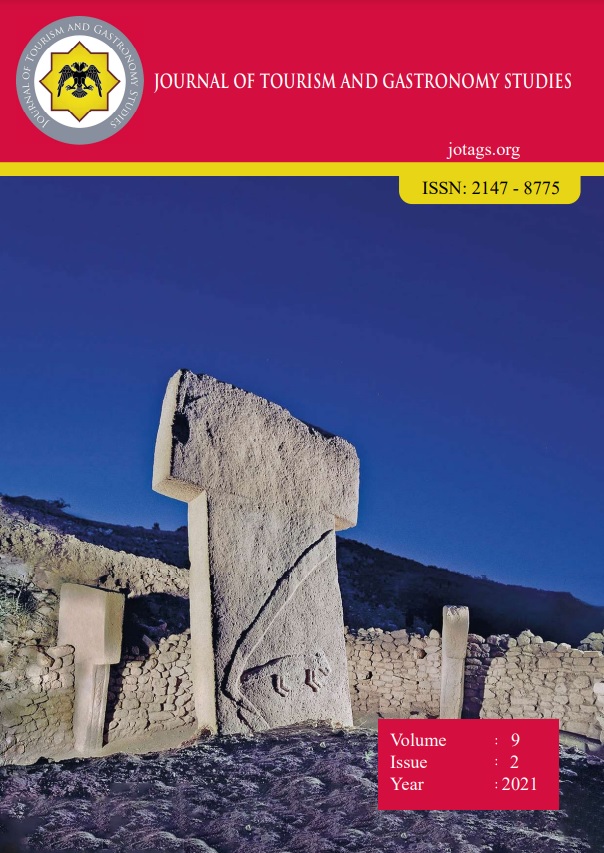
Published
Issue
Section
License
Copyright (c) 2023 Journal of Tourism & Gastronomy Studies

This work is licensed under a Creative Commons Attribution-NonCommercial 4.0 International License.